

Reviewed and Validated by: Naman Jain, Associate
Introduction – Intermediary Liability in India
Given the wide ambit of Intermediaries, Content Liability for Intermediaries needs to be brought within scope. This is important given the number of fake/hate posts being posted on Social Media. The test to determine whether an intermediary is to be held liable or not for content liability can be the ‘Test of Pecuniary Gain’, which is basically whether an intermediary is financially benefitting from the posting of the content or not. If yes, then the intermediary needs to put in a robust system(s) for approval of the content, including quality control, as can be prescribed by the Government of India, and regular audits of such systems by appropriate authorities.
WHO ARE INTERMEDIARIES?, SECTION 79 OF IT ACT, 2000
NEED FOR AMENDMENT
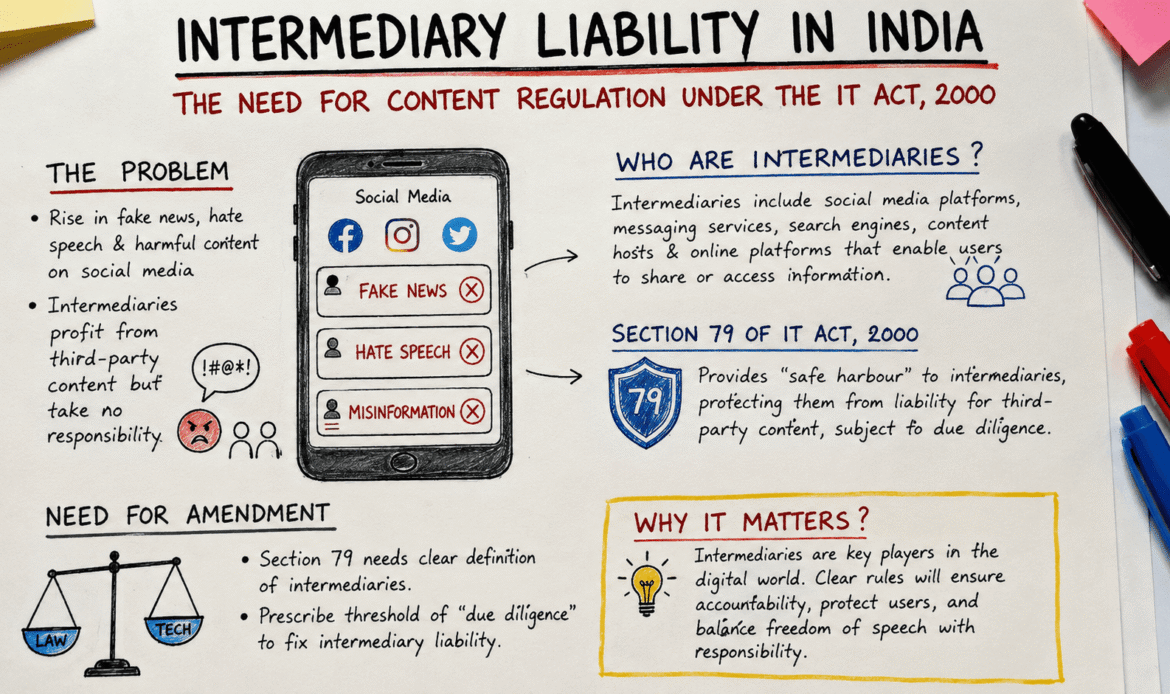
Section 79 of the IT Act, 2000 needs to be amended to clearly define the ambit and scope of Intermediaries. A key suggestion here is that Section 79 can be amended to prescribe the threshold of ‘due diligence’ about an intermediary’s liability.
Intermediaries are important players of the Internet world, and this step will go a long way in making them responsible for actions such as third party content being posted on their platforms.
CONTENT LIABILITY
A clear section on Content Liability for corporations and individuals needs to be provided for in the IT Act, of 2000. This is imperative especially since there is no section dealing with such actions post Section 66A being struck down in Shreya Singhal vs Union of India. There needs to be a defined criterion, ingredients, and definition of Content Liability in the IT Act, of 2000. The term needs to be clearly defined and made a non-bailable offense to be a deterrent for society.
The ‘Test of Pecuniary Gain’ can be the key standard used to determine when an intermediary is responsible for third-party content, demanding that platforms earning from third-party content provide thorough content moderation methods. Explicitly revising the Section 79 IT Act,2000 to set intermediary responsibilities and due diligence standards will bring much-needed clarity. Additionally, the lack of a specific provision on Content Liability after the Shreya Singhal judgment only buttresses the case for a better legislative fix. The Inclusion of Content Liability provisions in the IT Act, 2000, and classifying such Section 295 and 298 violations on these digital platforms as non-bailable offenses will go a long way in deterring misuse of these digital platforms. Some of these reforms will provide better legal certainty whilst also ensuring intermediaries act responsibly, balancing free speech with the need to prevent harm online.