


Reviewed and Validated by: Shubham, Associate
The Industrial Relations Code, 2020 has been published in the official gazette and as per the latest reports, the Code is slated to come into force as early as December, 2020. This comes immediately after the Code received the Presidential assent post being passed on 22nd September by the Lok Sabha and on 23rd September, 2020 by the Rajya Sabha.
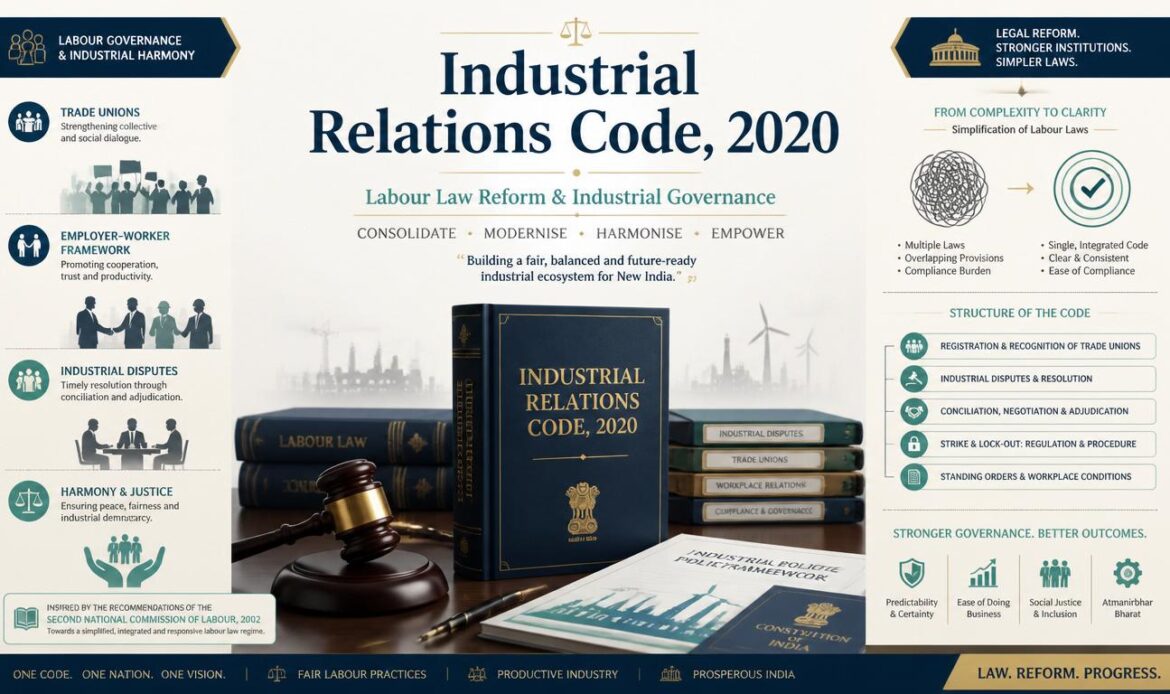
The Code repeals the laws on Trade Unions and Industrial Disputes and brings forth certain changes to the trade union and industrial disputes dynamics. That said, the general sentiment that the new Code has failed to address the teething problems of the law cannot be avoided. Pertinently, the Committee responsible for making the recommendation towards the Code i.e. the Second National Commission of Labour (2002) had found the existing labour laws to be “complex, with archaic provisions and inconsistent definitions” and the said committee had thus recommended the “consolidation of exiting labour laws into broader groups”. However, as can be practically seen, the law has not seen major transformations and with the rules yet to be notified, how this law pans out can only be seen through the passage of time and precedents.
Whilst the Rules are yet to be notified, the key provisions of the Industrial Relations Code are:
Works Committee
The Code requires the industrial establishments employing 100 or more workers to constitute a ‘Works’ committee. This Committee should comprise representatives of employer and workers engaged in the establishment. The Code stipulates that the number of representatives of workers in the Works committee shall not be less than the number of representatives of the employer.
Read another article: Procedure For Lay Off in India
Grievance Redressal Committee
Every industrial establishment employing twenty or more workers is required to out in place a Grievance Redressal Committees for resolution of disputes arising out of individual grievances. The Code stipulates the Committee to comprise of equal number of members from the employers and workers side respectively.
Controlled Industry
The Code of 2020 contains a provision stating that the Central Government will be the appropriate Government for any Controlled Industry which it may specify. It is to be noted that the Central Government has already been appropriate Government for the industries of railways, mines, telecom and banking.
Changes On The Compounding Of Offences
The 2020 Code on Industrial Relations allows for the compounding of offense punishable with imprisonment up to one year or with fine. Compounding is allowed in case of offenses with fine for a sum of fifty percent of the maximum fine provided for the specified offence and for offences which are punishable with imprisonment, compounding is allowed for a sum of seventy five percent.

Exemption On Public Interest
The appropriate government under the new Code of 2020 may exempt any new industrial establishment or class of establishments from the provisions of this Code providing the matter to be in public interest or for the benefit of the Public at large. The impact of this provision can only be gauged by the ambit of such establishments that the government decides should be kept out of the Code.
Change In The Number Of Workers
The Code mandates to all the industrial establishment having three-hundred workers that they must prepare standing orders on the matters Scheduled in the Code. These matters relate to: (i) classification of workers, (ii) manner of informing workers about work hours, holidays, paydays, and wage rates, (iii) termination of employment, and (iv) grievance redressal mechanisms for workers. Earlier this number of workers were one hundred. The Code removes the requirement that once an establishment is covered under the provisions related to standing orders, these provisions will continue to apply even if its employee strength reduces below the threshold (one hundred workers) at any time thereafter. Powers to the central government to revise the threshold has been removed by the Code of 2020. This Code only allows the Government an increase in the threshold through notification
Closure, Lay-Off or Retrenchment
Under the Code, an establishment having at least three hundred workers is required to seek prior permission of the government before closure, lay-off, or retrenchment.
Trade Union
Notably. if there were more than one registered trade union of workers functioning in an establishment, the trade union having more than fifty-one percent of the workers as members would be recognised as the sole negotiating union lowering the threshold from seventy five percent as per previous law. In the case where no trade union is eligible as sole negotiating union, the Code provided that a negotiating council will be formed consisting of representatives of unions that have at least twenty percent of the workers as members.
Additional Provision- Disputes Relating To Termination Of Individual Worker
The Code classifies any dispute in relation to discharge, dismissal, retrenchment, or otherwise termination of the services of an individual worker to be an industrial dispute. The worker may apply to the Industrial Tribunal for adjudication of the dispute. The worker may apply to the Tribunal forty-five days after the application for the conciliation of the dispute was made.
The Code provides the power to the central government to be an appropriate government for the purpose of Public Sector Undertakings even if the Central Government does not have holding of more than fifty percent in any Public Sector Undertakings, it will remain to be the appropriate government for such Public Sector Undertakings after the commencement of this Code.
