

Reviewed and Validated by: Aakrist Goyal, Associate
Empowering employees through Employee Stock Ownership Plans (ESOPs) is a strategic move that not only enhances morale but also aligns their interests with the company’s success. However, navigating the ways to issue shares under ESOPs requires a clear understanding of the available routes and their implications. In this article, we delve into the two primary methods of issuing shares under ESOPs – the Direct Route and the Trust Route – shedding light on their mechanisms and considerations. Let’s explore the intricacies of each route and the key points to bear in mind when adopting them.
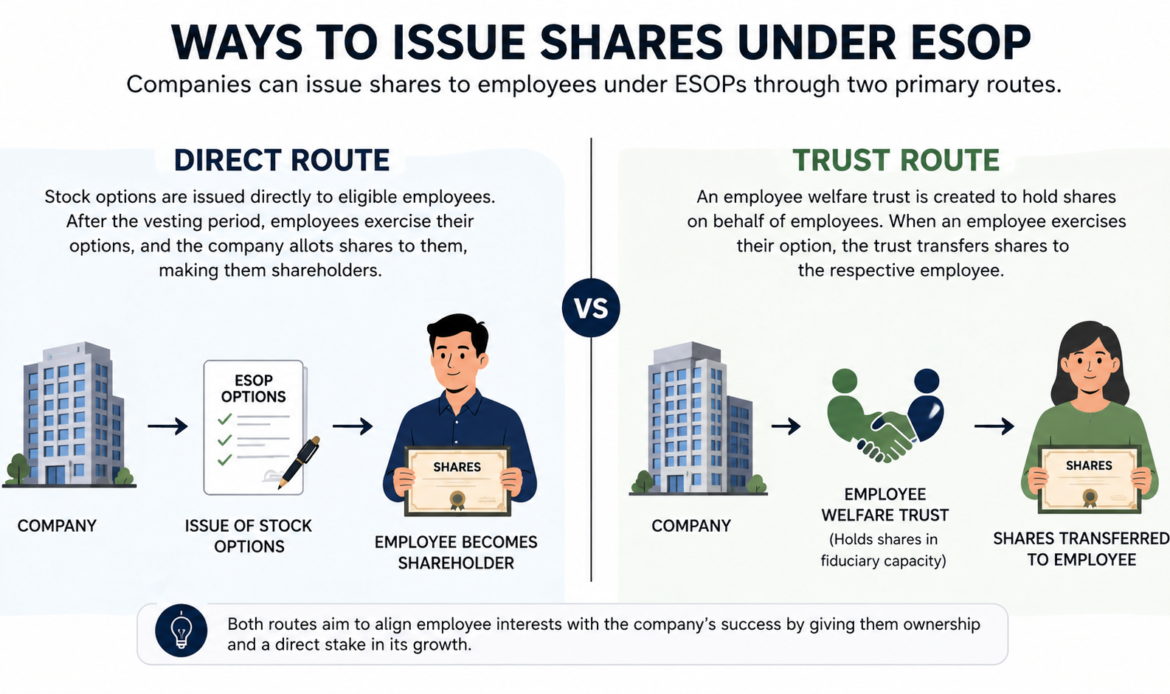
When it comes to issuing shares under ESOPs, companies have two main avenues: the Direct Route and the Trust Route.
- Direct Route: The Direct Route involves the issuance of stock options directly to eligible employees under the ESOP scheme. After the vesting period, employees exercise their options, and the company then allots shares to them. This route primarily entails the issuance of fresh shares, thereby transforming employees into shareholders.
- Trust Route: In this approach, a distinct entity known as an employee welfare trust is established. The trust assumes responsibility for holding shares on behalf of employees in a fiduciary capacity. Upon an employee’s exercise of their option, the trust facilitates the transfer of shares to the respective employee.
Read another article: Advantages of Employee Stock Option Plan
Considerations for issuing shares through Trust Route
- The Trust Route allows for the acquisition of existing shares as well as the issuance of fresh shares.
- If the trust engages in acquiring shares from the secondary market, it is subject to certain limits: a maximum of 2% of paid-up equity capital per financial year and an overall limit of 5% at any given time.
- Direct acquisition of shares from the company by the trust is not subject to any acquisition limit.
- Shares issued to the trust should be categorized under the non-promoter, non-public category in the shareholding pattern.
- Upon completion of a scheme, any remaining shares held by the trust may be utilized for another scheme with shareholder approval or sold, with the proceeds used in accordance with the trust deed.
- Section 67 allows a company to provide loans for the purchase of its own shares, specifically for ESOP purposes.
- If the trust borrows funds from the company to acquire shares from the secondary market, the loan is repaid using the proceeds received from employees exercising their share options.
- Shares acquired by the trust are classified under the non-promoter, non-public category in the shareholding pattern, and trustees do not have the authority to vote on behalf of employees regarding these shares.
Conclusion
In conclusion, the issuance of shares under ESOPs via the Direct or Trust Route demands careful consideration of various factors and legal provisions. By understanding the nuances of each route and adhering to regulatory requirements, companies can effectively implement ESOPs to incentivize employees and drive organizational growth.