

Reviewed and Validated by: Naman, Associate
Introduction
All agreements are contracts if they are made by the free consent of parties competent to contract, for a lawful consideration and with a lawful object, and are not hereby expressly declared to be void. Therefore, an agreement can only become a contract when the parties to a contract are competent to contract, the agreement involves a lawful consideration and a lawful object and the agreement has not been expressly declared to be void under any other law. The paper shall deal with capacity to contract at length.
It is a lawful mandate that the parties to a contract should be competent to contract otherwise there would exist no lawful contract. A contract cannot be entered into by parties which are not competent to enter into a contract.
Essentials of a Valid Contract
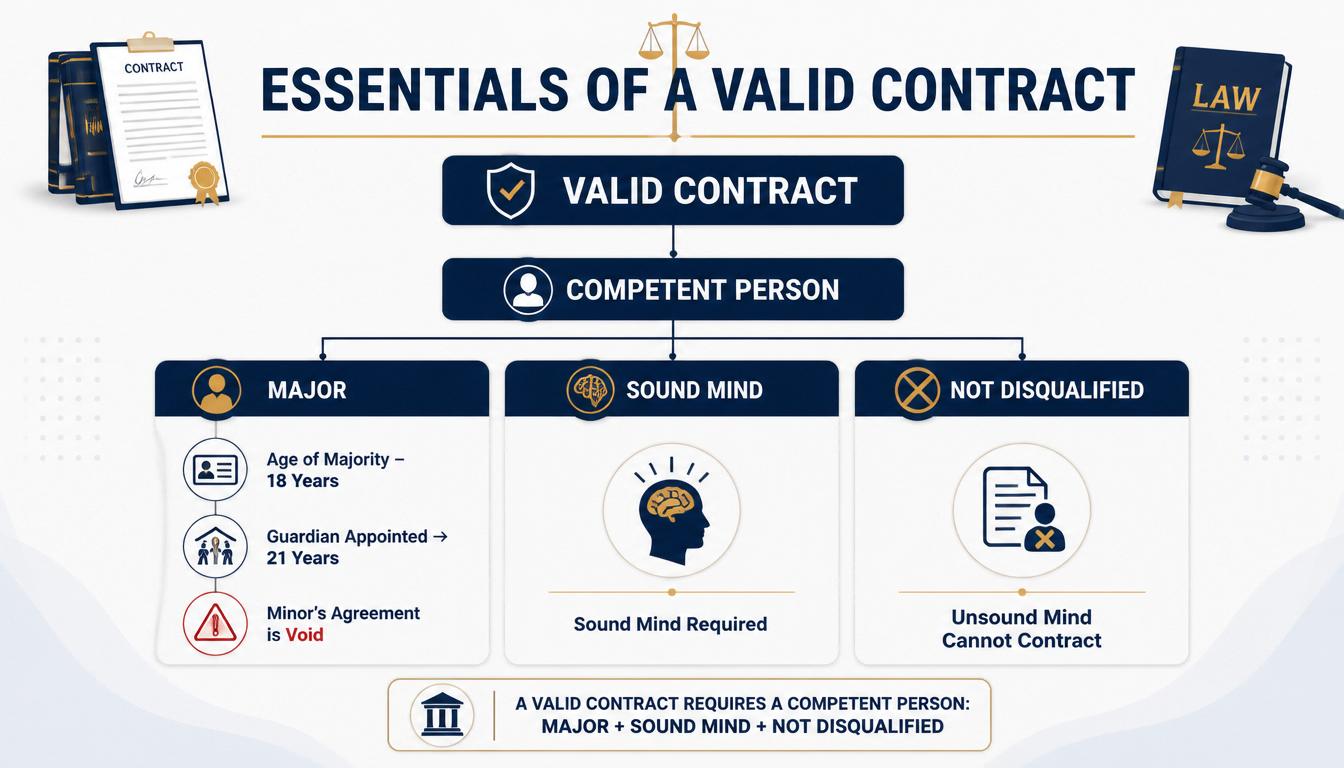
S.10 of the Indian Contract Act – For a contract to be a valid contract, the parties to the contract must be competent to contract.
Section 3 of the Indian Majority Act 1875 lays down the qualifications of a major. Every person domiciled in India shall attain the age of majority at the age of 18 and not before. Though, when a guardian of a minor or property is appointed by the court –minority continues up to the age of 21.
The minor’s agreement is void and unenforceable. Therefore, Even where the minor falsely represents to be major and thereby induces the other party to make agreement with him, he cannot be compelled to return the benefit or property received under the agreement under the Indian Contract Act.
S.11 of the Indian Contract Act – “Every person is competent to contract who is of the age of majority according to the law to which he is subject, and who is of sound mind and not disqualified from contracting by any law to which he is subject.”
From S.12 it becomes clear that a person who is incapable to understand the terms of contract and form a rational judgment as to its effect on his interest is not competent to make contract. The understanding may be affected by disease, drunkenness or some other cause. An idiot foolish by birth and always of unsound mind and therefore he cannot make a contract. A person of unsound mind is so intoxicated that he is not capable to understand the nature of contract and is incapable to form rational judgement as to its effects on his interest.
Read another article: Performance of Contract
Persons Disqualified from Contracting
A person who is usually of unsound mind but occasionally of sound mind, may make a contract when he is of a sound mind.
Examples of person who has been disqualified from contracting by some law –
- Alien Enemies
- Foreign Sovereigns and Ambassadors
- Professional Persons
- Married Women
- Corporation
- Insolvent
- Convicts
1.1. What is a Consent?
S.13 of Indian Contract Act, 1872 defines Consent as “Two or more persons are said to consent when they agree upon the same thing in the same sense.”
Consent = Unity of minds; “Consensus ad idem”
If there is no consent of the parties in the sense it has been defined in S.13, no agreement will be created and hence no contract.
What is Free Consent?
S.14 of the Indian Contract Act, 1872 defines Free Consent as:
- Consent is said to be free when it is not caused by
- coercion, as defined in section 15, or
- undue influence, as defined in section 16, or
- fraud, as defined in section 17, or
- misrepresentation, as defined in section 18, or
- mistake, subject to the provisions of sections 20, 21, and 22.
