

Reviewed and Validated by: Jefrin Johny, Associate
With Paytm IPO around the corner, we try to answer as to how Paytm’s operations in India classified and regulated under the relevant Reserve Bank of India regulations.
Paytm’s operations – a before and after story
While Paytm initially conducted its semi-closed system pre-paid payment instrument (“PPI”) Paytm wallet business in pursuance of the Certificate of Authorisation granted by the RBI under the ‘Reserve Bank of India (Issuance and Operation of Prepaid Payment Instruments) Directions, 2017 (Master Direction)’; subsequent to its obtainment of a license as a ‘payments bank’ from the RBI, its PPI business and associated license has been subsumed by such altered nature of business and registration as a payments bank with the RBI.
Paytm Classification And Regulation
The classification and regulation of Paytm’s operations in India may be examined in light of its initial operation of the Paytm wallet and the subsequent migration and linkage of such wallet to the Paytm Payments Bank as detailed hereinbelow.
1.1. Paytm Wallet
The issuance and operation of Prepaid Payment Instruments (“PPI”) is governed by the ‘Reserve Bank of India (Issuance and Operation of Prepaid Payment Instruments) Directions, 2017 (Master Direction)’ (“PPI Directions”) , issued by the RBI in pursuance of the powers conferred under the Payment and Settlement Systems Act, 2007, allowing for the issuance of Closed System PPIs (facilitate purchase of goods/services from the issuing entity only), Semi-Closed System PPIs (facilitate purchase of goods/services, financial services, remittance facilities etc. at clearly identified merchant locations and do not permit cash withdrawal) and Open System PPIs (can be used at any merchant; may be issued only by banks and facilitate cash withdrawal).
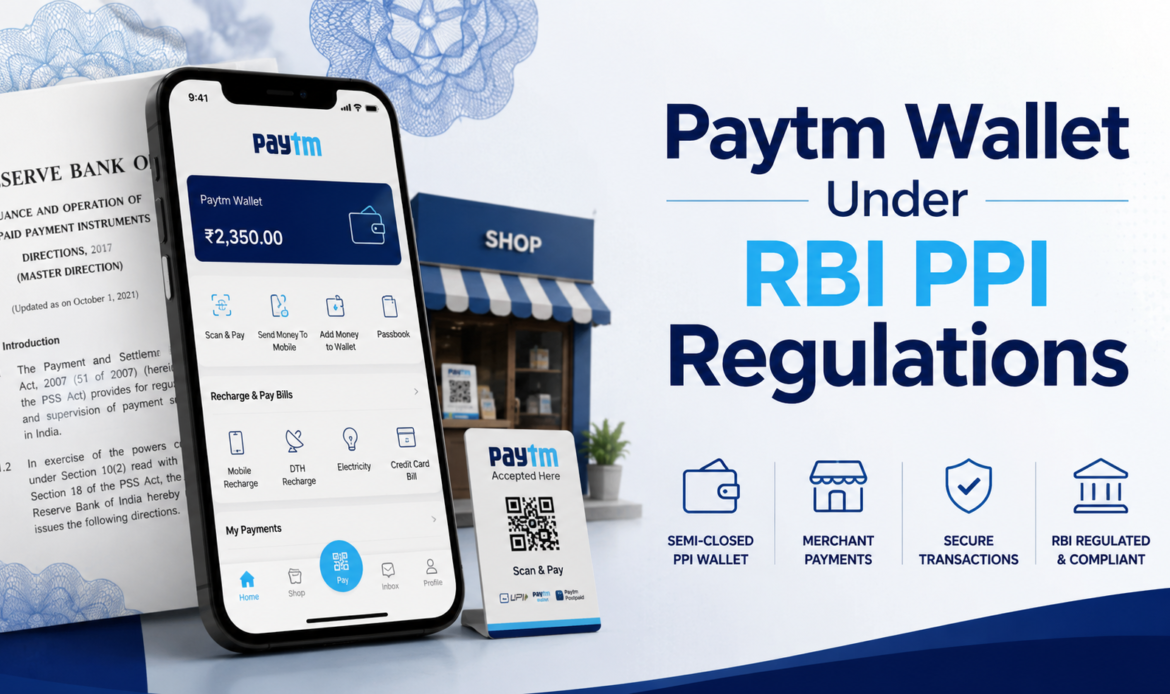
The PPI Directions provide that PPIs may be issued as wallets (amongst other instruments) and further provides that bank and non-bank entities that are compliant with the eligibility criteria under the PPI Directions and are duly authorised by the RBI shall be permitted to issue semi-closed system PPIs.
As the Paytm wallet facilitates interaction of the wallet-holder with third party vendors and merchants, it qualifies as a semi-closed system PPI; causing it to have obtained a Certificate of Authorisation from the RBI is such respect under the PPI Directions.
Read another article: ESOPs: Treatment Of Vested And Unvested ESOPs Upon Liquidation
1.2. Paytm Payments Bank
The RBI released ‘Guidelines for Licensing of Payments Banks’ on November 27th, 2014 (“Guidelines”), stipulating the procedure for registration as a payments bank, eligibility requirements and scope of activities etc. The Guidelines further provided that existing PPI license holders may opt for conversion into a payments bank. Subsequently, Paytm was granted an “in-principle” approval by the RBI under the Guidelines towards establishing a payments bank on August 19th, 2015 , with grant of the license subsequently undertaken by the RBI to One97 Communications Ltd.
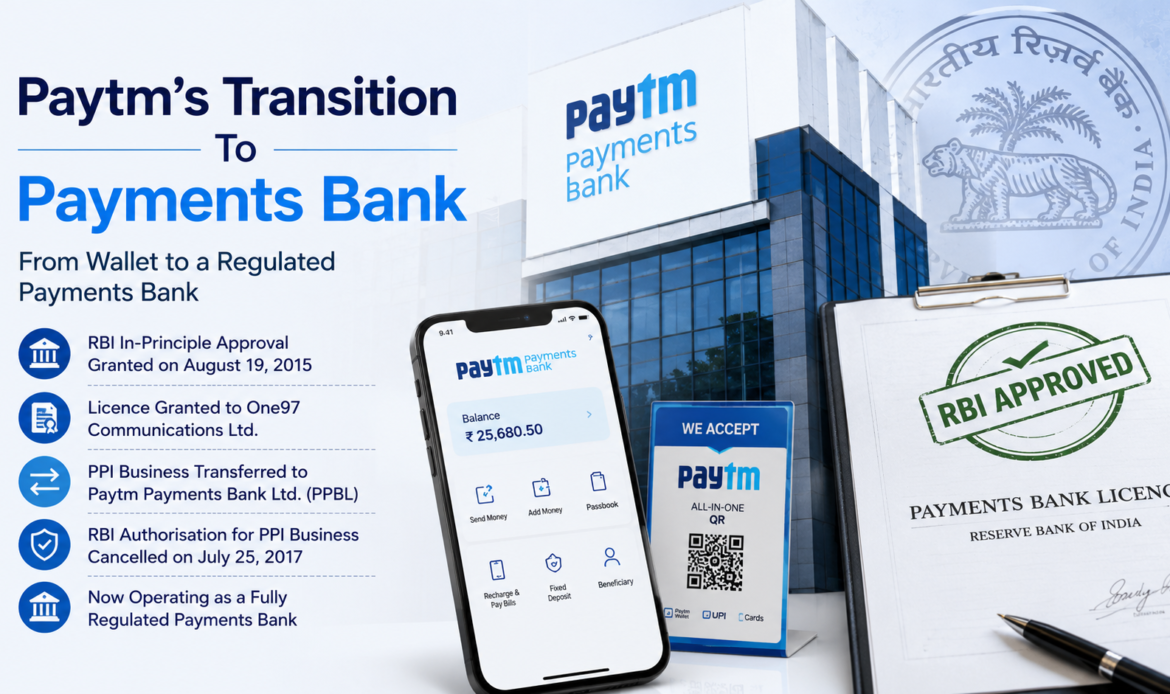
Subsequent to the grant of the above-stated license to operate the Paytm Payments Bank Limited (“PPBL”), Paytm effected the transfer of the semi-closed system PPI business to PPBL. Accordingly, the Certificate of Authorisation for the operation of semi-closed system PPI via the Paytm wallet has been cancelled on 25th July 2017, with such PPI business transferred to PPBL.
Thus, in the above manner, Paytm currently operates as a payments bank licensed by the RBI, with its semi-closed PPI vertical subsumed under the same.
While Paytm initially conducted its semi-closed system pre-paid payment instrument (“PPI”) Paytm wallet business in pursuance of the Certificate of Authorisation granted by the RBI under the ‘Reserve Bank of India (Issuance and Operation of Prepaid Payment Instruments) Directions, 2017 (Master Direction)’; subsequent to its obtainment of a license as a ‘payments bank’ from the RBI, its PPI business and associated license has been subsumed by such altered nature of business and registration as a payments bank with the RBI.
