

Reviewed and Validated by: Shreya Paharia, Advocate
When multinationals enter India through global capability centres, the focus is usually on scalability, talent, and long-term value generation. However, business priorities may change over time. Pressure of costs, global consolidation, changes in leadership, automation, or a revised market strategy may force the parent company to rethink its Indian operations. In that perspective, the real question is no longer expansion, but how to close a global capability centre or restructure it without triggering avoidable legal, taxation, employment, or regulatory concerns.
In India, a GCC cannot simply shut down its operations and walk away. The exit path is dependent on the legal form of the entity, that is, whether the entity has liabilities, what are the status of the employee contracts, foreign investment considerations, tax registrations, and whether the business is being discontinued entirely or only being restructured. A legally viable GCC closure process in India therefore begins with choosing the correct route, not just filing the final documents for the sake of it.
Why do companies close or restructure their GCCs?
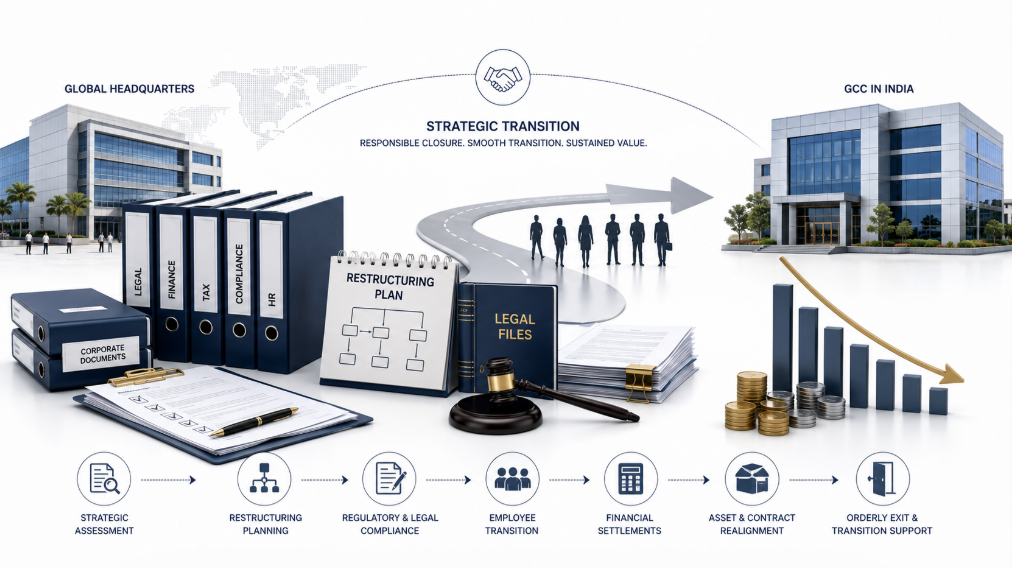
Usually, GCC exits are not caused by one significant event, but often they arise from a business reset. Foreign parent company may centralize its operations into another jurisdiction, merge group activities, reduce delivery functions, move from a captive model to a different model, or decide whether the Indian subsidiary aligns with the larger operating strategy or not. In a parallel world, the Indian entity remains valuable, but the structure does not align with the current strategy. This is usually where restructuring becomes more practical than mere closure.
Therefore, before initiating creation of documents, complete the first answer of the threshold question, that is, whether the plan to dominate the Indian presence completely or is it to preserve business continuity through a new business form, new owner, merger, or transfer of functions? This categorization influences the legal route. In real-time practice, Indian legal system considers strike off, liquidation, merger, and business transfer very differently.
Closure and restructuring may mean differently
Usually, a common mistake is to consider closure and restructuring as synonymous. However, they are not. A closure means that the Indian entity is being discontinued and ultimately dissolved or removed from the register. A restructuring means the business is continuing in some form, even if ownership, operations, number of employees, or the legal structure changes. For example, a foreign-owned subsidiary may transfer a business line, merge with another group entity, change its functions, or reduce operations while retaining the corporate shell. However, in such situations, the correct analysis is not merely the legal procedure for winding up a GCC, but whether a restructuring route better protects contracts, employees, IP, licenses, and tax efficacy.
The primary legal checkpoint is identifying the correct exit route. Before a company chooses the appropriate documents, it should map the entity against four questions:
- Is the Indian GCC solvent and free from defaults and liabilities?
- Does it still have employees, vendors, leases, tax dues, or any litigations?
- Is the parent looking for a complete exit or only a restructuring of a foreign-owned subsidiary in India?
- Lastly, does the entity operate in a regulated or a specified framework such as SEZ, GST, EPF, or sector-specific licensing? Furthermore, an Indian GCC may exit through three common routes.
The fastest strike-off, which is usually considered when the company is stopped the business as a non-liability and takes more of its name from the register under section 248 of the Companies Act 2013. Second one is voluntary liquidation, which is applicable when a solvent corporate person intends to liquidate itself under Section 59 of the Insolvency and Bankruptcy Code, 2016 and the IBBI Voluntary Liquidation Regulations, 2017. Third is restructuring, which may include merger, demerger, business transfer, group consolidation or share transfer depending on what the foreign parent company is trying to preserve or exit.
Option 1: Strike off for inactive or other clean entities
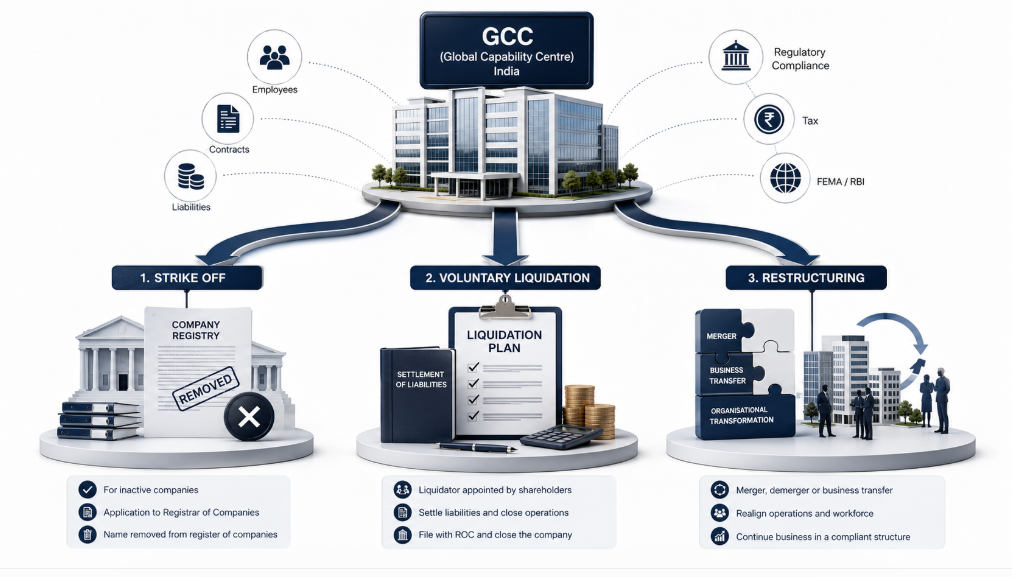
When the GCC has effectually become inactive and the company is not carrying out business operations, Section 248 of the Companies Act 2013 becomes applicable. This is the common route used when there is no need for a lengthy liquidation and the company can support an application for removal of its name from the register. In layman terms, this is the legal route for clean corporate exit, but only when the factual position is genuinely clean. However, strike off is not a casual shortcut. It is suitable only when the company is not using the shelf to park its assets, unresolved liabilities, or live compliance risks. If employee dues, vendor claims, tax exposure, ongoing proceedings, or material assets remain, a strike off-based exit can become vulnerable at a later stage. This is usually why many foreign group companies underestimate the groundwork required before filing for closure. The procedural filing may be short, but the pre-filing cleanup is when the real work happens.
Option 2: Voluntarily Liquidation for solvent but substantial exit procedures
When the GCC is solvent but has a more substantial legal and financial footprint, voluntary liquidation may be the most defensible route. Section 59 of the IBC Code allows any corporate person who has not committed default to initiate voluntary liquidation, and the process is usually governed by the IBBI Voluntary Liquidation Regulations. These regulations remain applicable and IBBI’s legal framework page shows updated version as recent as February 2026. This route is usually appropriate when the entity has contracts to terminate, employees to settle, books to close, assets to realize, or creditor processes that could be handled transparently. It is more structured than strike-off and therefore often more credible for foreign boards that want a documented exit trail. For a GCC with real operational history, voluntary liquidation may reduce the risk of later disputes over whether the company exited responsibly.
Option 3: Restructuring over closure
Sometimes the smarter move is not closure of business operations. If the parent company wants an Indian foothold and wants to retain staff or contracts or is only consolidating regional entities, restructuring may be the better route. A merger or amalgamation under the Companies Act can be relevant here. Section 233 of the Companies Act, 2013 provides a fast-track route for certain classes of companies, and the Ministry of Corporate Affairs also widens the scope of fast-track mergers through revised rules, including certain cross-border holding company structures involving an Indian wholly owned subsidiary. This matters because many GCC groups do not actually want a hard exit. They want simplification. In other cases, a merger, internal consolidation, business transfer, or a shift of ownership may protect continuity while achieving the commercial objective. From a strategic standpoint, this is usually the most efficient exit strategy for foreign companies in India when the business still has value.
Legal closure checklist for a GCC in India
No matter which route is chosen, the process should begin with an internal legal audit. This includes reviewing the company’s constitutional documents, foreign shareholding pattern, board approvals, employment contracts, vendor agreements, customer and group service agreements, leases, software licenses, IP ownerships, bank accounts, tax registrations, regulatory permissions, and pending disputes. Without this foremost mapping, closure documents may be filed before the entity is ready for exit. Second comes the liability identification. This includes employee dues, gratuity, notice pay, leave encashment, vendor settlements, inter-corporate balances, tax liabilities, PF and payroll exposures, and contractual termination costs. In India, closure risks usually surface not from the filing, but from legal obligations that outlive the fact. This is usually the most defensive GCC closure process in India, is one that treats closure as a project and not as a mere formality.
Applicability of employment law cannot be just another afterthought
For GCCs, employment is the most sensitive part of the closure. The Industrial Disputes Act contains specific provisions on closure notice and compensation. For instance, Section 25FFA requires notices to be sent to the appropriate government at least 60 days before the intended closure in the prescribed manner. Further, Section 25FFF provides for notices, compensation to eligible workmen in case of closure. Depending on the style of the workforce, state-specific shops, and establishments requirements, along with contractual level obligations, may also be applicable.
What does this mean?
This means an Indian GCC cannot rely solely on global HR communications. A closure should be in alignment with legally compliant exit documentation, settlement computations, full and final payment planning, and a clear distinction between workman, managerial employees, contractual staff, and leadership. When the company is restructuring and not closing, transfer or redeployment should also be documented meticulously.
In cross-border groups, this is often the stage when reputational risks become legal risks if not handled precisely. Foreign ownership and FEMA issues require utmost attention. When the GCC is a foreign-owned subsidiary, closing or restructuring usually cannot ignore FEMA and FDI rules. RBI’s master direction on foreign investment in India makes it clear that foreign investment compliance, sectoral caps, pricing rules, and exit conditions remain relevant. This also means that a non-resident investor is not guaranteed an assured exit price and that these exits must be in consonance with the prevailing price at the time of exit. In case of transverse pricing and valuation rules become particularly important, including when equity instruments are transferred or swapped. This is one of the biggest blind spots in restructuring a foreign-owned subsidiary in India. A company may complete its corporate filings but still mishandle valuation reporting or repatriation mechanisms. If shares are transferred, if a downstream structure is being unwound, or if a merger changes ownership lines, FEMA analysis must run in parallel with corporate law analysis and not subsequently.
Which red flags should companies resolve before they file for closure or restructuring?
Even when the board has decided to exit, legal teams should pause the process if any of the following remaining issues remain unresolved: employee disputes, unpaid statutory dues, mismatched in the company balances, pending annual filings, light leases, open tax inquiries, unsettled software or data transfer rights, or ambiguity over who owns GCC’s generated intellectual property. To simplify it, the legal procedure for winding up a GCC is not just about dissolution. It is about proving that the entity can be exited without leaving behind enforceable obligations. In case of foreign companies, this is particularly important because post-exit notices in India can travel up to group leadership advisors or successor entities in practical terms, even when the formal liability rules differ. The best approach is to make the entity closure-ready before making it closure-filed.
Frequently Asked Questions (FAQs)
Can a foreign company shut down its GCC in India just by ceasing its operations?
No, merely ceasing business activities does not legally close the Indian entity. A foreign company should follow the appropriate closure or restructuring route under Indian law, which also addresses employee settlements, tax registrations, ongoing contractual obligations, statutory compliances, and any other pending liabilities. An unplanned exit can leave the parent company exposed to certain regulatory and legal compliances which may be avoidable.
Is strike off the fastest and the best option to close operations of a GCC in India?
Usually not always. Strike off may work when the GCC is inactive and has no material liabilities and is genuinely ready for exit. However, if the entity still has employees, vendor dues, leases, tax exposure, assets or pending obligations, strike off may not be the safest route. In such cases, voluntary liquidation or a structured reorganization may be more legally viable.
What should a company review before starting the GCC closure process in India?
Before initiating any closure strategy, the company should review its employment obligations, inter-corporate arrangements, customer and vendor contracts, lease commitments, statutory registrations, tax filings, foreign investment compliances, and any pending litigations or notices. In real-time practice, the legal strength of a GCC exit solely depends on the final filing and more on how thoroughly these issues are resolved at the forefront.
How long does it usually take to close a GCC in India?
Complying with the legal route, there is no defined timeline. The duration completely depends on the chosen route, the entity’s liability profile, employee count, pending compliances, tax positions, and whether the company is closing completely or just restructuring. A clean and dormant entity may exit faster, while an operational GCC with employees, contracts, and regulatory touchpoints will require a more layered process.
What are the most common legal risks involved in closing or restructuring a GCC in India?
The most common risks include mishandling employee exits, overlooking foreign exchange and FEMA compliances, failing to close GST or other registrations, leaving contracts inadequately terminated, and choosing an exit route that does not match the company’s actual liability position. These gaps often surface after the business believes it has already exited, which is why closure planning must include legal, operational, and compliance considerations right from the beginning.
Conclusion
Closing a GCC in India is not just another compliance exercise. It is a strategic legal event. The right route depends on whether the subsidiary is dormant, solvent, asset-heavy, employee-heavy, or regulated, or still commercially viable in a different form. What looks like a simple exit can quickly turn into a complicated exercise if employment obligations, FEMA rules, tax registrations, or creditor issues are not integrated into the plan from day one. For foreign companies, the safest exit strategy in India is usually the one that starts early, documents all the steps, and aligns corporate labour tax and foreign exchange compliances before the final filing is due. Usually, in many cases, this also means that recognizing that restructuring is not a failed closure, but a better legal solution.
Corrida Legal helps companies on GCC closures and restructuring in India through legally repurposed commercially informed and execution-focused support. From evaluating the appropriate exit pathway to addressing regulatory employment and contractual considerations, the firm helps ensure a compliant and strategically sound transition.