

Reviewed and Validated by: Richa Thakur, Associate
Introduction
Non-compete clauses are a crucial element in employment contracts, especially in industries where trade secrets, sensitive information, and client relationships are highly valuable. This article examines the importance, scope, and enforceability of non-compete clauses in employment contracts in India, providing insight into how they are interpreted under the Indian Contract Act, 1872.
Importance of Non-Compete Clauses in Employment Contracts
Non-compete clauses, also known as restrictive covenants or non-competition agreements, are designed to protect an employer’s business interests by preventing employees from working with competitors or starting a competing business for a certain period after leaving the company. These clauses aim to:
- Protect Confidential Information: Safeguard sensitive business information and trade secrets.
- Retain Client Relationships: Prevent employees from taking clients to a new job or business.
- Maintain Competitive Advantage: Ensure that departing employees do not use insider knowledge to benefit a competitor.

Scope and Duration of Non-Compete Clauses
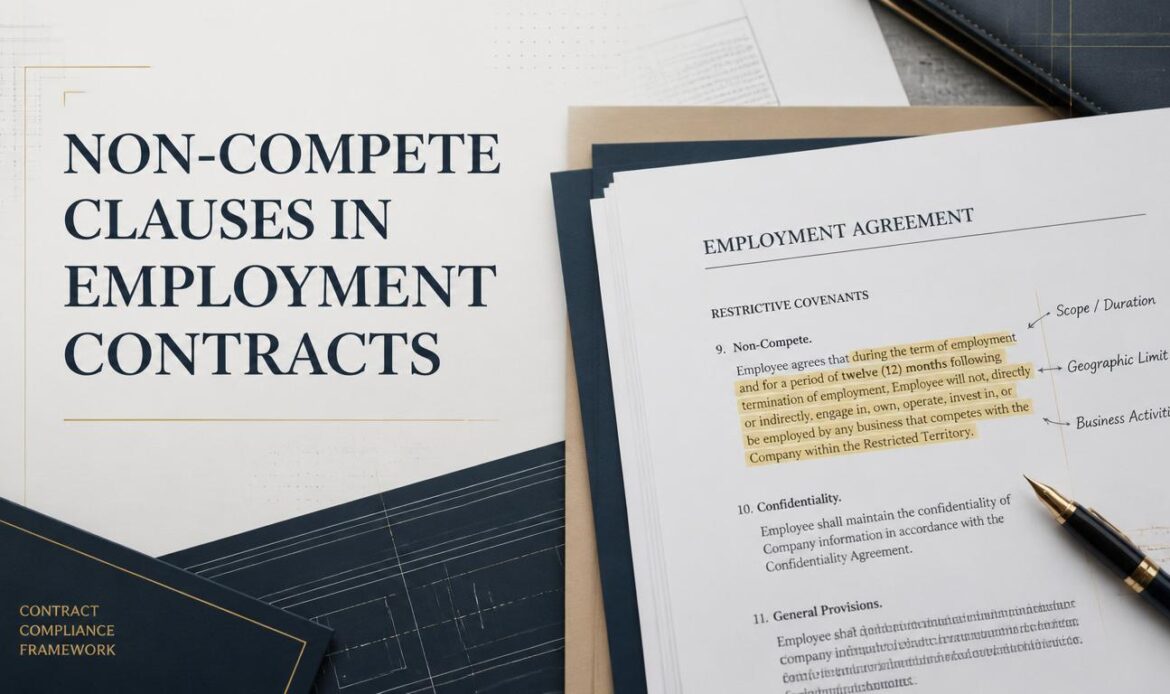
The scope and duration of non-compete clauses vary depending on the nature of the business and the employee’s role. Key considerations include:
- Geographical Area: Restrictions may apply to specific regions where the employer operates.
- Duration: The length of time the restriction is in effect, usually ranging from a few months to a few years.
- Scope of Activities: Specific activities or types of employment that are restricted.
Read another article: Overview of White-Collar Crimes in India
Reasonableness of Non-Compete Clauses
The enforceability of non-compete clauses largely depends on their reasonableness. Courts in India assess the following factors:
- Balance of Interests: The clause should strike a fair balance between protecting the employer’s interests and the employee’s right to work.
- Geographic Scope: The restricted area should be reasonable and not overly broad.
- Duration: The time period should be appropriate and not excessively long.
- Nature of Restriction: The clause should be specific to activities that genuinely protect the employer’s legitimate interests.
Judicial Interpretation of Non-Compete Clauses
Indian courts have provided guidance on the enforceability of non-compete clauses through various judgments. Key cases include:
- Niranjan Shankar Golikari v. Century Spinning and Manufacturing Co. Ltd.: The Supreme Court upheld the enforceability of non-compete clauses during the term of employment but emphasized the limited enforceability post-employment.
- Superintendence Company of India (P) Ltd. v. Krishan Murgai: The Supreme Court ruled that post-employment non-compete clauses are generally void unless they protect legitimate interests.
Case Law Analysis
Analyzing case laws helps in understanding the practical application of non-compete clauses:
- Percept D’Mark (India) Pvt. Ltd. v. Zaheer Khan: The Supreme Court held that a clause imposing a restraint after the termination of the contract was void.
- Wipro Ltd. v. Beckman Coulter International SA: The Karnataka High Court ruled that non-compete clauses during the term of employment are enforceable, highlighting the importance of protecting proprietary information.
Conclusion
Non-compete clauses in employment contracts are essential for protecting an employer’s business interests. However, their enforceability in India depends on their reasonableness and alignment with legal standards set by the Indian Contract Act, 1872. Employers should ensure that these clauses are carefully drafted to protect legitimate interests without unfairly restricting employees’ rights. Employees should be aware of the implications of signing non-compete agreements and seek legal advice if necessary.