

Reviewed and Validated by: Kartavya Ostwal, Advocate | Attendance and Working Hours Policy
Attendance and working hours policy often considered as just a policy to mention the timings and attendance procedures. However, in reality many disputes regarding attendance do not occur out of employee’s absence, but due to the fact that the policy does not specify the process of marking attendance, rules on late comings and early going, remote working and hybrid working attendance, attendance during traveling, unauthorized absence and consequences. It is often the office timings policy that creates many ambiguities in the minds of employee and problems for HR administration rather than the attendance policy itself.
For businesses operating in India attendance is not just a routine affair; it directly impacts salary administration. leave management records, evaluation of performance, continuity of business operations, and full and final settlement. In this context this article provides guidance on important aspects properly drafted attendance policy, attendance maintenance, working hour, overtime and employee duties.
Purpose of an Attendance and Working Hours Policy
The purpose of an attendance and working hours policy is to establish standards relating to punctuality, attendance recording and working hours and workplace discipline. It should help employees understand when they are expected to work, how attendance is marked, how absences are regularised and what happens if attendance rules are not followed.
The policy should also help managers and HR distinguish between genuine absence, approved leave, official travel, work from home, on-duty movement, late arrival, unauthorised absence and other attendance related matters.
The objective of this policy is to ensure efficiency , transparency and efficient operations in managing attendance and time management information.
Read another article : Revisiting the RBI’s Guidelines on Default Loss Guarantee in Digital Lending
Define Normal Working Hours
The policy should clearly state the normal working hours of the company.
Thus, for instance, a policy might prescribe that every employee will be responsible to work for nine hours per day and will work during prescribed office hours (with a lunch break).
Where the company has different working hours for different locations, teams, shifts, client projects or categories of employees, the policy should say so. If detailed schedule is maintained through HR portal, the policy should cross-reference such documents
The policy should also clarify whether breaks are included in working hours and whether tea or lunch breaks are fixed, flexible or subject to operational requirements.
Weekly Offs and Workdays
The policy should specify normal workdays and weekly offs.
For example, a policy may provide for workdays from Monday to Saturday, while another identifies Sunday as the weekly off.
This should not be left to assumption. Employees should know whether Saturday is a working day, whether weekly offs differ by location or role, whether shifts apply and whether weekly offs can be changed based on business needs.
If employees are required to work on weekly offs or holidays, the policy should specify approval requirements and whether compensatory off, additional pay or another internal mechanism applies.
Work on any weekly off or holiday shall be governed by applicable labour laws and Company policy relating to compensatory off and/or overtime pay.
Attendance Recording System
The policy should clearly state how attendance will be marked.
Attendance may be recorded through biometric systems, e-registers, HRMS, employee track systems, timesheets, project systems or any other company-approved method. One attendance framework requires employees to log into the e-register every day, and another requires attendance through biometric punching machines.
The policy should also state that manual attendance regularisation may be restricted or allowed only in defined circumstances. Where absence is not regularised after reminders, it may be treated as leave or unauthorised absence, depending on the policy.
Employee Responsibility for Timekeeping
Employees shall be responsible for recording their working hours accurately.
In remote work arrangements, employees may be required to monitor working hours through the company’s timekeeping system and diligently record hours so that salary, attendance and payment records remain accurate.
This responsibility should apply equally to office, hybrid and remote employees, with the method of recording adapted to the work model.
The policy should make clear that failure to mark attendance, failure to regularise attendance or incorrect attendance recording may affect leave, pay, performance and disciplinary action.
Late Coming and Early Departure
A practical attendance policy should address late coming and early departure.
The policy may allow limited grace periods in genuine personal or family exigencies, provided the employee informs the reporting manager.
It may also provide escalating consequences for repeated late marks, such as deduction of leave, salary deduction, disciplinary action or inquiry where the pattern becomes excessive.
The drafting should be proportionate. A one-time delay should not be treated like misconduct. But repeated late coming, early departure or attendance irregularity should be capable of action when it affects work or becomes habitual.
Disciplinary measures will not commence before giving the Company may provide counselling, written warning depending on the nature and recurrence of their behaviour.
Office Movements and On-Duty Work
Employees may be required to leave the workplace for official meetings, client visits, local travel, outstation travel or other work-related assignment .
The policy should require all official visits, travel schedule and out-of-office movements to be appropriately recorded in the designated attendance, travel management or employee tracking system.
Where employees are on tour, they should intimate the number of days of tour to the department head and HR before departure.
This avoids later disputes on whether the employee was absent, on duty or travelling for official work.
Travel-Related Attendance Clarifications
Attendance rules should account for practical travel situations.
Where employees return late at night from official travel, the policy may allow delayed office attendance the next day based on the time of arrival. Where employees need to start official travel during the day, the policy may allow them to skip office attendance or leave early, depending on the travel schedule.
Local travel should also be addressed. If an employee has an early client appointment, the policy may allow the employee to go directly from residence to the client office. If the appointment is later in the day, the employee may be required to attend office first or inform HR and the department head as per the policy.
These details may look small, but they prevent repeated attendance disputes for sales, operations, field, consulting and client-facing teams.
The Company may allow exceptions to the attendance policies during times of natural disaster, government mandates, public emergency, transportation problems or other factors beyond employee’s control
Remote Work Attendance
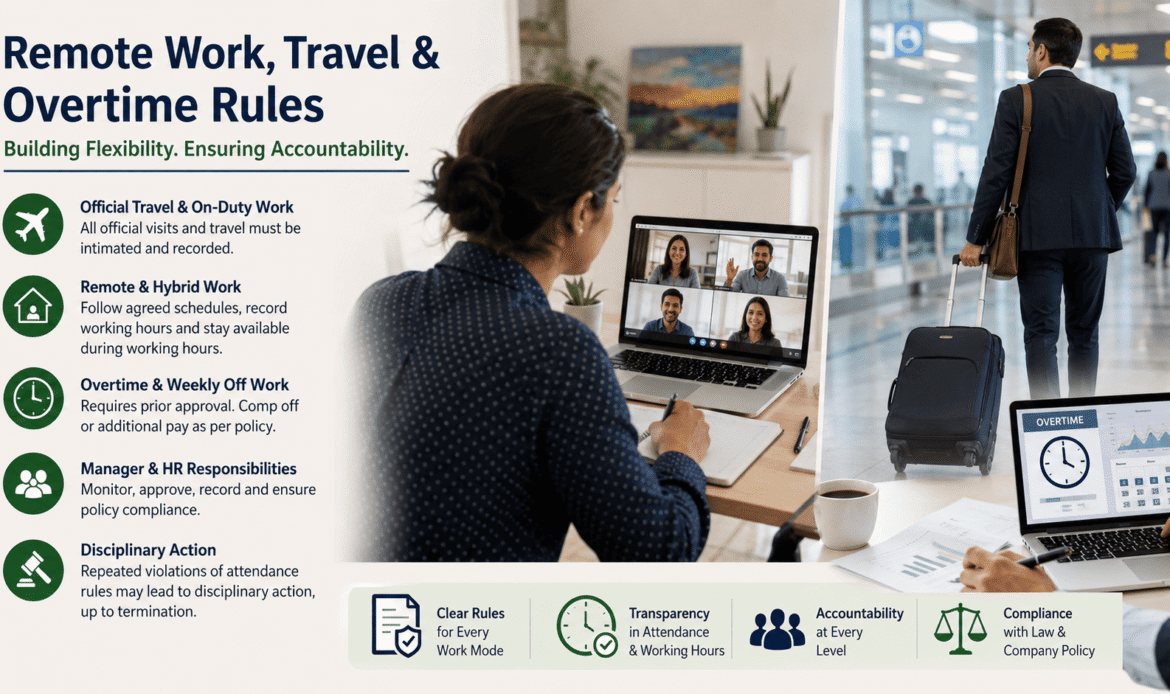
Remote employees should follow the attendance schedule agreed with their manager.
A remote work policy may require employees to be punctual, follow the schedule agreed with the manager, inform HR and the reporting manager as soon as reasonably practicable in case of absence or delay , and record working hours through the company’s timekeeping system.
Remote employees home working should not, however, be perceived as an open ‘flexible working hours . They must remain available for work, attend internal and client calls and complete regular working hours applicable to internal or client projects.
Hybrid Work Attendance
Hybrid work attendance should be aligned with the hybrid work policy.
Where employees are required to work from office on specified days and from home on other days, the attendance policy should identify how office attendance is recorded, how remote attendance is recorded and how flexible schedules are approved.
Employees working remotely during hybrid work should remain available and responsive during designated working hours, maintain communication with their teams and ensure productivity in accordance with company policy
This prevents employees from treating hybrid work as optional attendance.
Absence Regularisation
The policy should define how absence is regularised.
If an employee fails to mark attendance, arrives late, leaves early or is absent for part of the day, the employee should submit the required regularisation request to the reporting manager , HR or administration within the prescribed timeline.
If the absence is due to official work, the employee should submit the relevant on-duty form, travel form, manager approval or HR intimation, as applicable.
The policy should also state what happens if absence is not regularised. It may be treated as leave, on unpaid leave or unauthorised absence, depending on the company’s policy and facts.
Unauthorised and Unreported Absence
Unauthorised absence should be clearly addressed.
A remote work attendance policy may state that unexcused or unreported absence for more than three days will be considered job abandonment and that the company reserves the right to terminate employment in such an event.
The policy should also allow room for genuine emergencies. Severe accidents, family emergencies or acute medical emergencies may be treated as excused absence, and the company may request medical documents or other verification when required..
This balanced approach protects the company from unexplained absence while preserving fairness in genuine cases.
Attendance and Salary
Attendance records should be linked with salary processing.
Unexcused and unreported absences may not count as hours worked and may not be compensated.
Where attendance is not regularised, the company may treat the absence as leave or loss of pay, depending on the policy.
This link should be made clear to employees because many attendance disputes arise at payroll stage.
Legal Compliance Considerations
Attendance and work hour policies should be aligned with relevant employment laws, wages need, overtime. Company policies should not interfere with statutory rights available to employees.
Overtime and Additional Work
The policy should regulate overtime and additional work.
One employment agreement structure states that the employee may be required to work additional hours necessary for proper performance of duties and that overtime or compensatory off will be provided in compliance with applicable law for such additional work.
A hybrid work policy may also state that no employee should work overtime without prior managerial approval.
This is important because Employees should not work additional hours without prior approval and later claim that overtime was implied. At the same time, Managers should also avoid informally require extra work without recording the approval or treatment.
Working on Weekly Offs or Holidays
If employees are required to work on weekly offs or holidays, the policy should require prior approval.
One workplace policy state that for working on off days, employees should take prior permission from the HOD and inform HR by email. It also provides that compensatory off may be availed only within a defined period.
A remote work policy may also provide comp off or fixed payment for work on Sunday for a client or billable project, subject to the employee using the comp off within the specified period.
The company should clearly document how such work will be approved, recorded and adjusted.
Manager and HR Responsibilities
Managers and HR should both have defined roles.
Managers should approve schedules, track punctuality, review late coming and early departure, verify official movements, approve regularisation requests and escalate repeated attendance issues.
HR should maintain attendance records, review regularisation requests, ensure policy consistency, support payroll processing and maintain documentation where disciplinary action is required.
For branch or location-based teams, a local administrative responsibility may also be assigned, including maintaining physical muster and sending records to HR at month-end.
The above documents shall be maintained for such period as required under applicable law or the record retention policy of the Company.
Disciplinary Action for Attendance Breach
The policy should provide for disciplinary action where attendance breaches are repeated, wilful or work-affecting.
A remote work policy may provide corrective counselling as the first attempt but allow stricter action where counselling does not work, the employee is wilfully tardy or absent, tardiness or absenteeism is repetitive, or it impacts work.
This is a useful structure because it avoids treating every attendance issue as misconduct, but still preserves disciplinary control where attendance issues become serious.
Sample Attendance and Working Hours Policy Clause
Employees are required to observe the working hours, attendance requirements, weekly offs, leave approval process and timekeeping procedures notified by the Company from time to time.
Employees shall mark their attendance through the attendance system prescribed by the Company, including biometric attendance, e-register, HRMS, timesheet, employee tracking system or any other approved method. Employees are responsible for ensuring that their attendance and working hours are accurately recorded.
Employees shall attend work on time and shall not leave work early without approval. Any late arrival, early departure, absence, failure to mark attendance, official travel, client visit or out-of-office movement must be recorded and regularised in accordance with the Company’s process.
Employees working remotely or under a hybrid working arrangement shall follow the schedule agreed with their reporting manager, remain available and responsive during working hours, attend required internal and client calls, and record working hours in the designated system.
Employees shall not work overtime or on weekly offs or holidays without prior approval from the reporting manager or other authorised person. Any approved overtime, compensatory off or additional payment shall be handled in accordance with Company policy and applicable requirements.
Any absence that is not supported by approved leave, approved work-from-home arrangement, official travel record, on-duty approval or other authorised record may be treated as unauthorised absence, leave without pay or misconduct, depending on the facts and Company policy.
Repeated late coming, early departure, failure to record attendance, unreported absence, unauthorised absence or misuse of attendance records may invite disciplinary action, including termination in serious cases.
Company may have the right to change, amend, interpret or revoke this policy at anytime depending on its operational needs and adherence to applicable laws.
Practical Drafting Checklist
- Define normal working hours.
- Define workdays and weekly offs.
- Specify lunch and rest breaks.
- State how attendance is marked.
- Define employee responsibility for timekeeping.
- Regulate late coming and early departure.
- Define grace period, if any.
- Require regularisation of missed attendance.
- Regulate office movements and client visits and on duty activities.
- Regulate local and outstation travel attendance.
- Define remote work attendance rules.
- Define hybrid work attendance rules.
- State overtime approval requirements.
- Regulate work on weekly offs and holidays.
- Link attendance with salary and leave payroll processing.
- Define unauthorised absence.
- Allow medical or emergency exceptions.
- State disciplinary consequences.
- Define manager, HR and branch administration responsibilities.
Common Drafting Mistakes
- The first mistake is mentioning office timing without defining attendance recording.
- The second mistake is not explaining late coming and early departure.
- The third mistake is not regulating official travel and client visits.
- The fourth mistake is not defining remote work attendance.
- The fifth mistake is not requiring timekeeping for remote employees.
- The sixth mistake is allowing overtime without prior approval.
- The seventh mistake is not linking unreported absence with pay treatment.
- The eighth mistake is failing to allowing genuine emergency exceptions.
- The ninth mistake is not defining manager and HR responsibilities.
- The tenth mistake is failing to define disciplinary consequences for repeated attendance breaches.
FAQs
What should an attendance policy contain?
An attendance policy should contain working hours, weekly offs, attendance recording system, late coming rules, absence regularisation, travel attendance, remote work attendance, overtime approval and consequences for unauthorised absence.
Should employees be required to mark attendance daily?
Yes. Employees should mark attendance through the company’s prescribed system, such as biometric attendance, e-register, HRMS or timekeeping system. Failure to do so should require regularisation.
How should late coming be handled?
The policy may allow limited grace periods for genuine exigencies, but repeated late coming may result in leave deduction, salary deduction, disciplinary action or inquiry in accordance with company policy.
How should attendance be handled during official travel?
Employees on tour or official visits should inform the reporting manager and HR and record the movement in the prescribed attendance or employee tracking system.
Should remote employees follow attendance rules?
Yes. Remote employees should follow the schedule agreed with their manager, inform HR and the manager if absent or late, and record working hours through the timekeeping system.
Can unreported absence be treated seriously?
Yes. A policy may treat unexcused or unreported absence beyond a defined period as job abandonment, subject to the company’s process and facts.
Should overtime require prior approval?
Yes. The policy should require prior managerial approval for overtime or work on weekly offs and holidays.
Corrida Legal Note
An attendance and working hours policy should create discipline without becoming rigid or unfair. It should help employees understand working hours and attendance responsibilities, help managers regularise genuine exceptions, and help HR act consistently where absence, late coming, overtime or timekeeping issues arise.